

Wait! Don’t Go Yet! 👋
We see you eyeing those adorable outfits! 😍 Before you leave, here’s 10% OFF your first order!
Hurry, your little one’s next favorite outfit is waiting! 🛍️✨
Choosing a dining table is about far more than finding a design you love. The shape of your dining table can completely change how your dining area looks, feels and functions. It influences how many people you can comfortably seat, how easily you can move around the room, how conversations flow during meals and even how spacious the room appears.
Two of the most popular choices for South African homes are round and rectangular dining tables. Both can create beautiful dining spaces, but each works particularly well in different room sizes, layouts and lifestyles.
At Woodbuilt Furniture, we believe the right dining table should balance beautiful design with everyday practicality. Before deciding between round and rectangular, consider the size and shape of your dining area, the number of people you regularly accommodate and how you use the space.
Understanding Your Dining Space
Before looking at table styles, start with the room itself.
A dining table should never feel squeezed into its surroundings. There needs to be enough space for dining chairs to pull out comfortably while still allowing people to walk behind them.
As a general guideline, aim for approximately 90 cm of clearance between the edge of the dining table and surrounding walls, cabinets or other furniture. Where the dining area forms part of a busy walkway, providing closer to 100–120 cm can make movement considerably more comfortable.
The proportions of the room can also help determine which table shape will look most balanced.
A square or compact dining area often suits a round dining table, while a long or rectangular room generally works beautifully with a rectangular dining table.
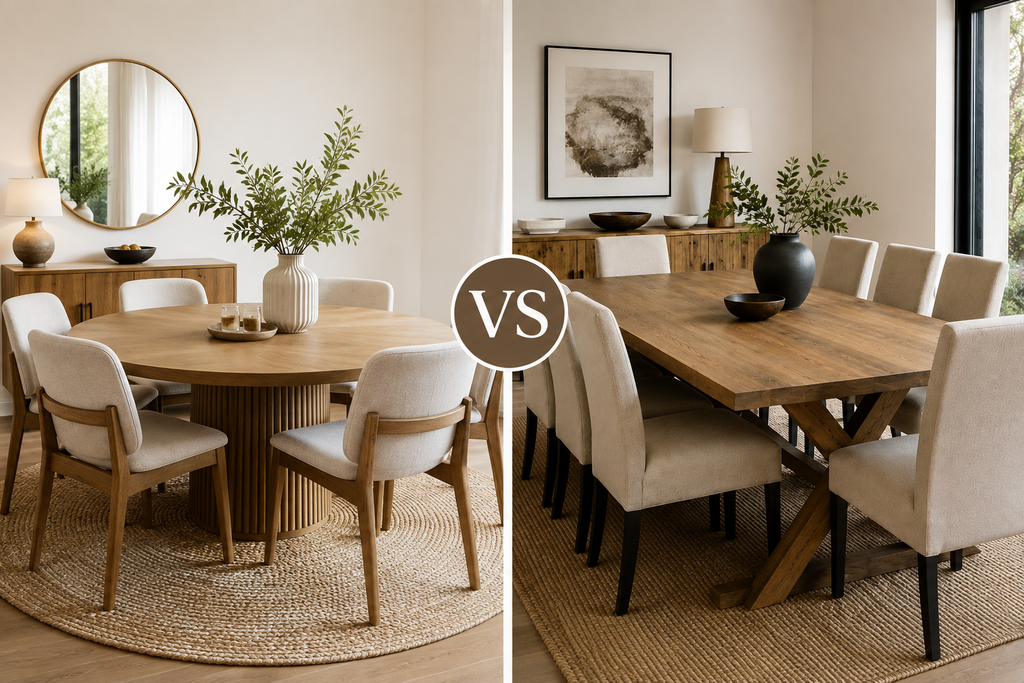
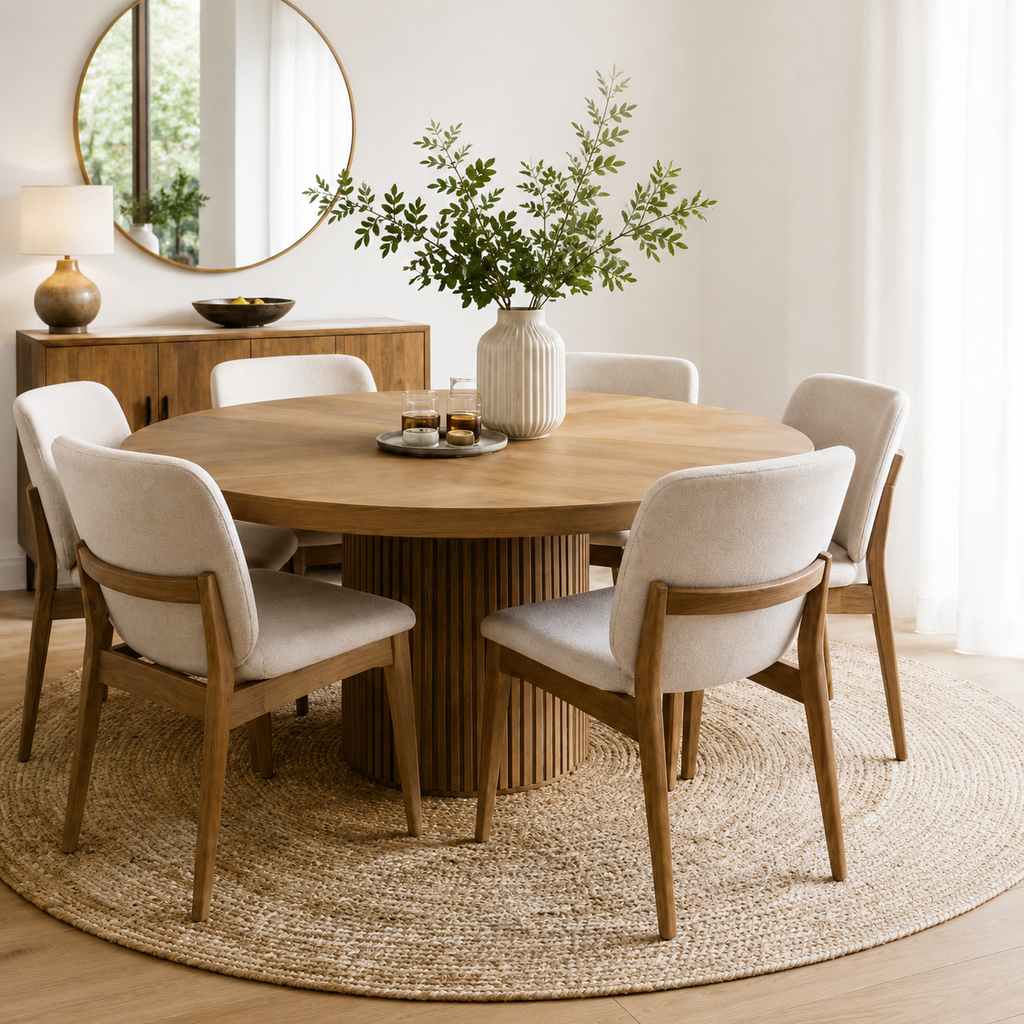
Round dining tables bring softness and flow into an interior. Without sharp corners or long straight edges, they can make a dining area feel relaxed, inviting and visually balanced.
They are particularly effective in smaller dining rooms, breakfast areas and open-plan spaces where maintaining easy movement around furniture is important.
Ideal for Smaller Spaces
One of the greatest advantages of a round dining table is its ability to make efficient use of compact spaces.
Because there are no corners projecting into the room, walking around the table can feel easier. This is especially useful in apartments, townhouses and smaller contemporary South African homes where dining areas may need to make the most of every available centimetre.
A pedestal-base round table can provide even more flexibility because there are fewer table legs competing for legroom underneath.
Creates a More Social Dining Experience
Round tables naturally encourage conversation.
Everyone seated around the table faces towards the centre, making it easier for guests to see and speak to one another. There is no traditional “head of the table”, which creates a relaxed and inclusive atmosphere.
For families who regularly sit together for dinner or homeowners who enjoy intimate entertaining, this can make a round table particularly appealing.
Creates Softer Visual Lines
Modern homes often contain many straight architectural lines — walls, kitchen islands, cabinets, windows and sofas.
Introducing a round dining table helps break up these lines and adds contrast to the room. The curved silhouette can soften an interior and create a more organic, welcoming appearance.
This works particularly well with Scandinavian, contemporary, minimalist and organic-modern interiors.
Excellent for Open-Plan Living
Many modern South African homes feature combined kitchen, dining and living spaces.
A round table can help define the dining zone without creating a heavy visual barrier between different areas. Its curved edges allow the eye to move naturally around the space, helping an open-plan room retain a sense of flow.
Round tables are extremely practical at smaller sizes, but very large round tables can become less convenient.
As the diameter increases, the centre of the table becomes more difficult to reach. Guests seated directly opposite one another also become further apart.
If you regularly need seating for eight, ten or more people, a rectangular table may therefore provide a more practical solution.
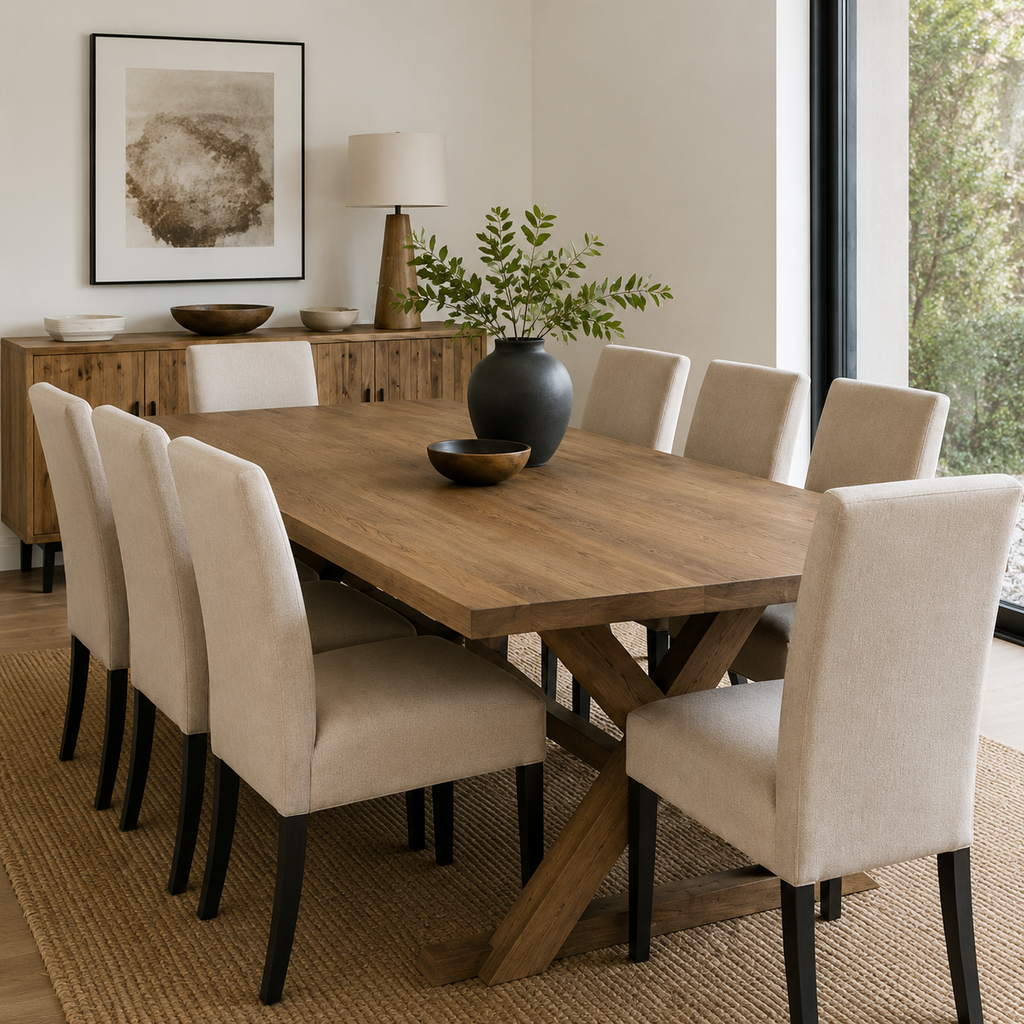
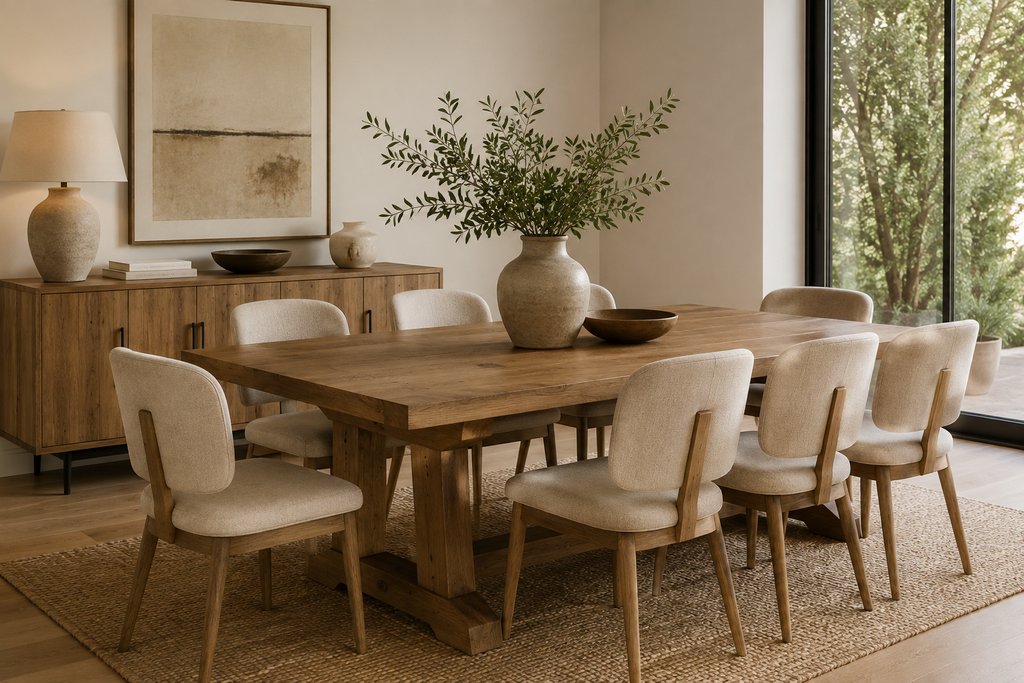
Rectangular dining tables remain one of the most versatile and timeless choices for dining rooms.
Their elongated shape works naturally with the proportions of many dining spaces and provides generous surface area for meals, serving dishes and decorative styling.
They are particularly suitable for larger families, frequent entertainers and longer dining rooms.
More Seating Capacity
If accommodating more people is a priority, rectangular dining tables generally provide greater flexibility.
Chairs can be arranged along both sides of the table with additional seating positioned at either end. Depending on the table’s length, this makes it relatively easy to accommodate six, eight, ten or even more guests.
This makes rectangular tables an excellent option for larger households and homeowners who regularly host family gatherings.
Perfect for Long or Large Dining Rooms
Furniture tends to look most balanced when its proportions complement those of the room.
A rectangular dining table naturally follows the length of an elongated dining room, creating visual harmony and making effective use of the available floor space.
In larger open-plan homes, a substantial rectangular table can also create a strong visual anchor between the kitchen and living area.
Generous Tabletop Space
Rectangular tables generally provide plenty of usable surface area.
Alongside individual place settings, there is often enough room for serving platters, centrepieces, candles and decorative accessories without making the table feel overcrowded.
This can be particularly useful when hosting larger meals or celebrations.
Works Beautifully with Dining Benches
Another advantage of rectangular tables is their compatibility with benches.
A dining bench can be positioned along one side of the table and paired with individual chairs on the opposite side. This creates a relaxed contemporary dining arrangement and can sometimes allow additional guests to be accommodated.
A bench can also be tucked underneath certain table designs when not in use, helping maintain a cleaner appearance.
Neither shape is automatically better — the answer depends largely on the proportions of your room.
For a small or square dining area, a round table often makes the space feel less crowded and allows smoother movement.
For a long rectangular dining room, a rectangular table generally uses the available floor area more efficiently.
Open-plan areas can accommodate either option. A round table can create a softer transition between kitchen and living spaces, while a rectangular table can visually define a larger dedicated dining zone.
Your household size and entertaining habits should play a major role in your decision.
As a practical starting point:
| Table Type | Typical Seating |
|---|---|
| Small Round Table | 2–4 people |
| Medium Round Table | 4–6 people |
| Large Round Table | 6–8 people |
| Small Rectangular Table | 4 people |
| Medium Rectangular Table | 6 people |
| Large Rectangular Table | 8 people |
| Extra-Large Rectangular Table | 10+ people |
These numbers should be treated as guidelines rather than strict rules because seating capacity depends on the exact dimensions of the table, the width of the dining chairs and the position of the table legs or pedestal.
Wide dining chairs and chairs with armrests require considerably more room than narrow armless designs.
The table is only half of the dining arrangement.
Before purchasing a table, consider the dimensions of the chairs you intend to use with it.
Most standard dining tables are approximately 75 cm high, while dining chair seat heights are commonly around 45–50 cm. This generally creates comfortable clearance between the chair seat and tabletop.
Chair width is equally important when determining how many chairs will fit around the table.
For example, six slim armless dining chairs may fit comfortably around a particular table while six wider upholstered armchairs may feel overcrowded.
Always consider the complete dining set rather than calculating seating capacity from the table alone.
The design underneath your dining table can have a surprisingly large impact on comfort.
Traditional four-legged tables are timeless, but the position of the legs can sometimes limit where chairs can be placed.
A pedestal dining table removes legs from the outer corners, often providing greater flexibility when positioning chairs. This is one reason pedestal bases are particularly popular with round dining tables.
Rectangular tables may feature four legs, double pedestals, trestle bases or sculptural central supports.
If maximum seating flexibility is important, check where each person’s legs will sit in relation to the table base before making your final decision.
Both options can work beautifully for family living.
A round table can be especially practical for younger families because its curved edges eliminate sharp corners and create a more intimate environment for everyday meals.
A rectangular table may be preferable for larger households because it offers more seating and additional tabletop space.
Consider not only how many people live in your home today, but also how the dining table is likely to be used over the coming years.
For smaller dinner parties where conversation is the priority, round tables are excellent. Guests can easily interact without being separated into different sections of the table.
For larger gatherings, rectangular tables generally have the advantage because they can accommodate more guests while maintaining comfortable place settings.
If entertaining is an important part of your lifestyle but space is limited, an extendable dining table can provide an excellent compromise. It can remain compact for everyday use and provide additional seating when guests arrive.
Table shape also contributes significantly to the overall character of your dining room.
Round dining tables tend to create a softer, relaxed and contemporary appearance. They pair beautifully with curved dining chairs, bouclé upholstery, natural timber and organic accessories.
Rectangular dining tables can create a stronger architectural presence. Depending on the materials and base design, they can complement modern, farmhouse, industrial, Scandinavian and sophisticated contemporary interiors.
However, there are no strict design rules. A traditional rectangular table can look striking with contemporary chairs, while a sculptural round table can become a statement feature in a classic interior.
A round dining table may be the better choice if:
A rectangular dining table may be better if:
The perfect dining table is ultimately the one that suits your home, your family and the way you live.
Choose a round dining table when you want to maximise a smaller space, encourage conversation and introduce softer lines into your interior.
Choose a rectangular dining table when you need greater seating capacity, have a longer dining area or regularly entertain larger groups.
Most importantly, don’t choose your dining table based on appearance alone. Measure your space carefully, consider chair dimensions, allow sufficient clearance around the table and think realistically about how many people will use it.
A beautifully designed dining table should not simply fill a room — it should make the room work better.
At Woodbuilt Furniture, we believe dining spaces should bring together thoughtful design, everyday comfort and lasting style. Whether you prefer the intimate character of a round table or the generous proportions of a rectangular design, choosing the right shape will help create a dining space where family meals, celebrations and everyday moments can be enjoyed comfortably for years to come.

